Tuesday, April 16, 2019

Is Moz Domain Authority Important for SEO?

Authority and rank metrics like Moz’s Domain Authority can be incredibly useful for all of your SEO campaigns but when taken at face value or misinterpreted, these metrics can lead you astray of important goals and leave you chasing ROI shadows.

The point of any ranking or authority metric is to mimic a search engine ranking algorithm. Companies like Moz have invested heavily and built these calculations on the backs of crawlers that index pages, count links, evaluate topicality, and use machine learning to provide insights into how well your website might rank against a competitor.

There are quite a few ranking metrics on the market today. Some of the more well-known ones include Majestic’s Trust Flow and Citation Flow, Ahrefs’ Domain Rating, and Moz’s Domain Authority.

Let’s dive into one of the most used authority metrics out there: Moz Domain Authority.

What is Moz Domain Authority?

The Moz Domain Authority, or DA, is a proprietary metric that attempts to predict how well your website will rank on a scale of 1-100.

DA is a good indicator of a website’s potential for organic visibility. Moz also calculates the Page Authority (PA) for a specific URL, scoring it the same way that it does for the domain as a whole.

You can quickly check your DA with the MozBar Chrome extension.

MozBar comes in a few different flavors. The default view gives you DA scores and linking breakdowns for all the pages in a search results page, or once you click through to a page, the DA score and analysis for that page.
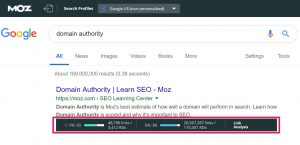
mozbar domain authority score in google serp

A lighter, more simplified view is the DA mode which only shows the score of the page you’re on in the extension icon.

mozbar domain authority score in DA mode

What Does Moz DA Measure?

Moz DA measures links: links, links, and more links.

The Moz score measures inbound links from other sites to your specific pages, inbound links to any of your sub-domains, and inbound links to anywhere on your root domain. It also adds up the number of unique domains and the total quantity of links pointing at your site.

From the Moz Domain Authority explainer:

“Domain Authority is calculated by evaluating multiple factors, including linking root domains and number of total links, into a single DA score. This score can then be used when comparing websites or tracking the “ranking strength” of a website over time. Domain Authority is not a metric used by Google in determining search rankings and has no effect on the SERPs.”

Moz is taking all of the link data from their Link Explorer tool for a given website and matching that up against other domains in their index.

Did you see the catch there?

The score is based only on the Moz index of the web, not Google’s or anyone else’s. Their metric is only as good as its index, which got a lot better last year when Link Explorer replaced Open Site Explorer (OSE), increasing the size of their index 35x and the freshness of their index 30x.

Moz DA 2.0 Update

You may have heard recently about a shake-up with Domain Authority. Moz overhauled the way that they were calculating DA, and marketers and webmasters went into a tizzy. Some sites’ scores went up while others’ went down.

The most important thing to know is that Domain Authority got better. The size of Moz’s link data set got bigger and fresher while they worked in ways to better interpret the link data by incorporating their Spam Score and adding a dash of machine-learning.

So, if you were closely monitoring your Domain Authority scores and they went up on or around March 5, 2019, keep doing what you’re doing. Maybe even more of it.

If your DA dropped off a cliff, you weren’t penalized — it was because your links stink. Moz got significantly better at assessing the quality of the inbound links pointing at your website, and their DA is now a more accurate reflection of Google’s algorithm.

I recommend conducting a little backlink audit and updating that disavow file as soon as you get the chance.

Is Domain Authority a Ranking Factor?

No.

Domain Authority is not a Google ranking factor.

DA is a Moz metric.

Google doesn’t use it. Bing doesn’t use it. DuckDuckGo doesn’t use it.

But, as Googler John Mueller cheekily pointed out during an AMA last year, DA does exist, and Google is aware of it:
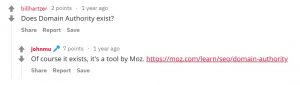
domain authority comment from john mueller

How Should You Use Domain Authority?

Domain Authority and similar authority and ranking scores are great as a comparative metric. They should never be used as an absolute measurement of how well your website is doing in organic search. Keep a close eye on your scores and your competitors’ scores over time, especially when there are coordinated campaigns with dedicated outreach efforts.

If you have a link building campaign running alongside on-page optimizations of sections of your website, you’ll be able to show the correlation between on- and off-page factors driving in high-quality traffic.

Then, add DA over time to a reporting dashboard that highlights all the traffic being driven to your campaign’s target pages.
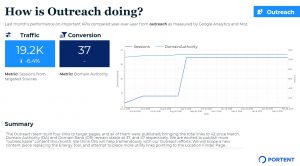
tracking domain authority in google data studio

Moz Domain Authority should only be used as a part of your overall tracking strategy; it should never be the sole measurement.

And after the 2.0 refresh, it is one of the best reflections of how Google might be analyzing and ranking your website. As long as you know how to use it (and how not to use it), DA will be a reliable indicator of how well you will perform against your competitors in the SERPs.

The post Is Moz Domain Authority Important for SEO? appeared first on Portent.

Friday, April 12, 2019

Five Principles Of Advanced SEO

This post does not pick on Google. It picks on us. We’re passive. Lazy. Dependent on Google to give us SEO advice. We jump on bandwagons and apply hacky fixes. Then we say we’re practicing “advanced SEO” because we know how to use noopener.

Advanced SEO isn’t about scouring webmaster hangouts, applying the latest Google patches, and then calling it a day. You want to be “advanced”? Understand five principles:

1: Google Recommendations Are Not SEO Recommendations

Rule number one trumps all other rules.

Apply Google’s recommendations, and a website is visible. Our job isn’t to make sure a site is visible. Any competent developer can do that.

An SEO’s job is to ensure a website can sustainably compete for organic rankings and conversion-generating traffic.

An advanced SEO is always aware that Google is not making SEO recommendations.

2: Always Read The Fine Print

Everyone talks about javascript and its impact on SEO. Search engines tell us “We can render javascript.”

They can! But javascript is risky. Rendered does not equal ranked.

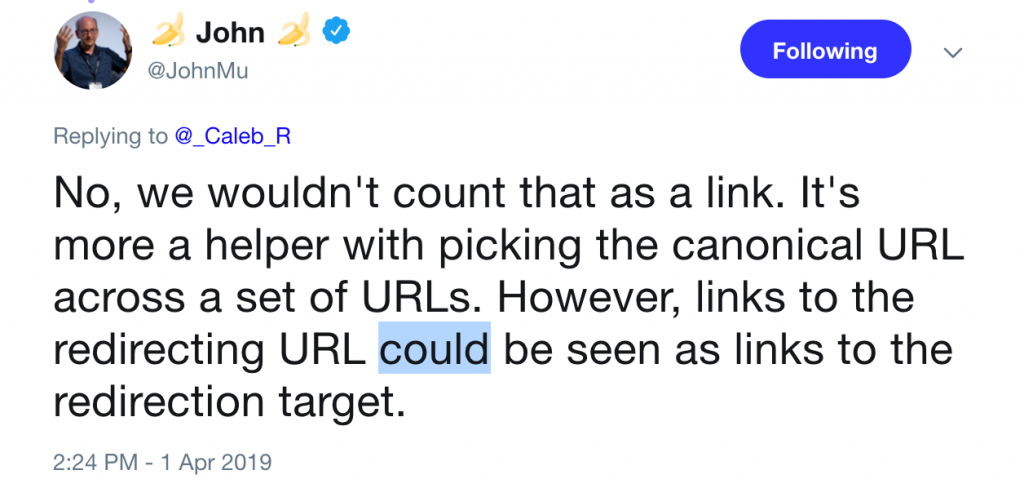
That’s one example. There are plenty more. Here’s Google talking about 301s and links. I added the highlighting:

Image: When Google says could - beware

Read all of Google’s guidance with skepticism and rule #1 in mind. Watch for “could” and “might” versus “do” and “does.”

Read the fine print.

3: Remove Problems. Don’t Hide Them.

Now and then, the search engines give us Remedies: Stuff like rel=canonical. Search engine support for remedies comes and goes.

Google said nofollow would work for link sculpting. Then they said otherwise, sparking the worst nerd riot in history. Folks pelted the stage at SMX Advanced with branded stress balls and iPhone cases. Horrifying.

Google supported rel=next/prev. Until they didn’t.

Remedies change. Shit that just works, though? That’s forever. Don’t mitigate. Fix.

4: Reduce Abstraction

Don’t put more stuff between your content and browsers/bots.

Prerendering and hybrid solutions create additional layers. Redirects create extra hops. Avoid them whenever possible.

Reduce abstraction. Give Google a direct path to your content.

5: Learn The Tools

You can be “advanced” if you don’t know how to analyze a log file, or do fancy natural language processing (I can’t). But you need to be prepared to learn.

That sounds trite. But “learning” doesn’t mean reading the latest blog posts. It means digging into the command line, hacking around with some code, and learning how search engines work.

Read someone’s great GREP tutorial(cough cough).

Learn on-page SEO and natural language processing. Understand how to measure shingling (and what it is, too).

I can’t list everything because I’m still figuring it out myself.

Corollary: Advanced SEO Doesn’t Replace The Basics

By the way: Advanced isn’t a replacement. It’s an amplifier. It makes the basic, nuts-and-bolts SEO tactics more effective.

So spend all the time you want geeking out about natural language processing and isomorphic javascript (I do).

But you’d better spend even more time on title tags, internal linking, and the words you use on a page.

If you skip the basics, all the fancy-schmancy advanced tactics in the world are worth exactly nothing. You’re giving Google a chocolate chip cookie without chocolate chips. That’s bound to piss anyone off.

Advanced SEO means giving me my chocolate chip cookie.

End of rant.

The post Five Principles Of Advanced SEO appeared first on Portent.

Thursday, April 11, 2019

What to Look for In Your Digital Marketing Agency

Finding an agency that can act as a true partner is hard.

They all claim they can help you out no matter what their specific focus is. They all have case studies and recommendations. So, how do you choose the right digital marketing agency for your needs?

If you’re thinking about hiring an agency for the first time or about to switch to a new one, here’s what you should look for in a digital marketing agency.

Clear Communication

The most important aspect of partnering with an agency is how well you communicate together. They could be the most brilliant marketers on the planet, but if you can’t reach them or they can’t talk to you the way you need, it’s worthless.

Accessibility

You’d think this would be a basic standard for any agency, but I’m floored by how many times I’ll hear a client talk about how another contractor or agency hasn’t responded to phone calls or emails after a few days. If your agency doesn’t get back to you within 24 hours on all emails or calls, it’s time for a new one.

Brand Knowledge

Your agency may never know the ins and outs of your product or service as well as you do, but they should be able to talk about all the aspects of it in great detail. If they can’t answer the value proposition of your product, how can they sell it? If they can’t talk about your customer like it’s their own, how can they market it?

Expectation Management

Your agency might get back to you quickly and seem attentive, but often you’re feeling like things are late or information is missing. This is probably because they’re not managing your expectations well. Look, sometimes issues pop up or things don’t go exactly as planned. However, if your agency isn’t getting out in front of it and letting you know why and what that means for the big picture, it means disorganization.

Transparency and Accountability

The biggest things I look for in a colleague are transparency and accountability. This builds trust and is the backbone of any long-term relationship. Why not hold your digital agency to the same standard?

Making Mistakes

Agencies are made up of humans and humans make mistakes – there’s no way around that. As much as we like to think we know everything, we can’t possibly predict the future or guarantee our work will affect the positive change we plan for.

The key is how your agency responds when a ball is dropped.

Do they try to tiptoe around it and make excuses that don’t quite feel right? Or do they own it, fix this issue, and use it as a learning experience to improve their work moving forward? Hopefully, it’s the latter, and it’s a form of optimization.

If they seem to be hiding something, then you can’t be sure they’re helping your business.

Goals and KPIs

Does your agency collaborate with you to develop Key Performance Indicators (KPIs) and goals for your engagement? If not, then they’re not holding themselves accountable. They should document clear KPIs with quantifiable goals that align with your overall business objectives. If they depend on you for all their goals and KPIs, then they’re likely focused solely on tactics and not enough about results.

Business Reviews and Post Mortems

Your agency should push for business reviews on a regular basis. The agenda should look at the performance of the previous quarter and outline a roadmap for the upcoming quarter. This will give everyone a chance to see the big picture and not get bogged down in small tactics and deliverables.

A post-mortem is a bit like a business review but is more about short-term campaigns or entire accounts at large. They are generally less formal and are more about working out the kinks. These are also extremely useful but can happen on an as-needed basis.

Strategy-Driven

We’ve covered all the things that make an agency a solid partner, but what about the substance in what they do? At the end of the day, no matter how well they communicate and how accountable they are, your digital marketing agency needs to master digital strategy.

How do you know if an agency is as good as they say they are?

T-Shaped Skill Set

Although you might be hiring an agency for a specific channel, they need to have a T-shaped skill set. Each expert you work with should be knowledgeable in all digital marketing channels. This is because no single channel operates independently. All digital marketing is part of an ecosystem, and in some way or another, each channel affects the others.

Take our marketing stack, for example. If their content team doesn’t know how to work with analytics, they won’t be able to see advanced user behavior. If their PR team doesn’t understand link building, then they may be wasting valuable effort. They don’t have to be certified masters of each channel, but even a dedicated channel agency should know how their channel works with all the others.

This is extremely important for whoever is managing your account at the agency. They have the bird’s-eye view on overall performance, and if they don’t understand the fundamentals, then it’s a ship without a captain. They should be considered a strategist as well.

Tactics vs. Strategy

Tactics mean nothing without the strategy to back them up. One of the surefire signs that your agency is phoning it in is when they rely on tactics without strategic reasons. Sure, keyword analysis is fine, but why? What will this get you? Don’t be intimidated by your experts, and always feel free to ask why. If they can’t answer this easily and clearly, then they don’t know why either.

Roadmaps

As I mentioned before, all business reviews should include a roadmap. This roadmap should be a game plan of tactics, action items, and deliverables that they want to accomplish next. It should be strategy-driven, and every single item should have a purpose.

If your agency isn’t providing you with a roadmap, then they’re leaving you in the dark. They could be doing all the right things and making all the right moves, but if you’re often wondering what they’re up to, this leaves room for all sorts of potential issues. It’s a matter of accountability.

Team Mentality

Your digital marketing agency should be a good partner for you. This means they should not only do the work you’ve asked them to do, but they should feel like part of your team. You should never feel like they’re just hired marketing mercenaries.

Educators

Does your agency take the time to teach you things? One of the aspects our clients love most about us is that we love to teach them about what we do. If there’s a new Google algorithm update that may not affect them, we still like to let them know about it and what it means. If we’ve read any good articles on something about their industry, we’ll share those with them, too.

One easy way to find out how much teaching an agency will likely do for you is through their thought leadership. Do they have a blog, and how active is it? Are their articles basic, or are they interesting? Is just one person responsible for all the articles, or do all of their strategists contribute?

Adventurous

Your agency shouldn’t be scared of new opportunities. They should vet them out properly but be excited to explore with you. If you’ve ever come to them with a new idea and they dismiss it without a solid reason, then you certainly won’t be able to grow with them. There is a fine line between being cautious and being stubborn.

Honest Feedback

Do you feel like your agency challenges you? Do they push back on occasion? Another telltale sign that your agency isn’t trying hard enough is that they do whatever you say without any pushback or questions.

Our best clients are the ones that we are able to openly disagree and debate with. We can do this because they trust us and respect what we have to say. As a Client Partner, the worst thing I can do is not vocalize potential pitfalls. Expressing these dangers shows I care. Your agency should care, too.

Provide You With Ownership

Does your agency claim ownership on the work they do for you? Shockingly enough, it happens, and it’s a major red flag.

The only reason that an agency would want to retain ownership of the work they’ve done is that they’re afraid you’ll leave, and they want to maintain leverage. This does not inspire confidence in their abilities. If they’re as good as they say they are, then they’ll have no problem handing everything off to you. If they don’t easily deliver everything to you, then imagine what it would be like if you decide to stop working with them.

(This obviously doesn’t apply to certain situations in which you’re accessing previously produced material or IP from your agency.)


The bottom line is that if you feel like your agency isn’t working with you, then they’re probably not doing a great job of working for you. Hold them to extremely high standards. Challenge them, and let them challenge you back. You’ll end up getting much more bang for your buck and hopefully have a long-term partner to help you get where you want to go.

The post What to Look for In Your Digital Marketing Agency appeared first on Portent.

Tuesday, April 9, 2019

Improve Your Quality Scores With These Simple Tips

Quality Score is a key metric that should be used to indicate the potential for keyword, ad group, and campaign success in paid search.

On its face, Quality Score is simple: it measures the relevancy and cohesiveness of three components required for every PPC campaign:

  • The keywords within an ad group
  • The ad copy searchers see when an ad is triggered
  • The landing page searchers visit after clicking your ad

The more relevant and cohesive those three components, the higher your Quality Scores will be. Simple enough, but let’s dig in a little deeper.

Why is Quality Score So Important?

Before diving into how to maximize your QS, it’s important to understand why improving Quality Score is important.

Quality Score matters because the QS of a given keyword directly impacts Ad Rank in the auction.

The higher your Quality Score, the better your Ad Rank has the potential to be. As Ad Rank improves, the chances of your ad earning a click grows and the cost you’ll pay per click can decrease.

The bottom line: Having a high QS sets you up with the best chance to pay as little as possible for the ad position you earn and the clicks you drive.

By saving money there, advertisers can see improvements in cost per conversion figures and can drive more traffic to their targeted pages if they are constricted to stay within a set spending budget.

How to Maximize Quality Score

There are three primary metrics which guide the QS assigned to a given keyword.

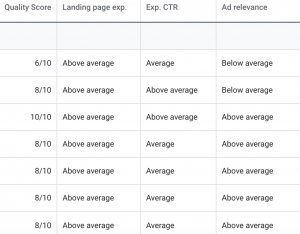
Advertisers can see the status of these factors when analyzing Quality Score in Google Ads as each will have a status of “Below Average”, “Average”, or “Above Average.”

Here’s a snapshot of what advertisers can quickly view in the Google Ads interface for these metrics:

Quality Score Examples in Google Ads

Expected Clickthrough Rate

Google defines Expected CTR as “A keyword status that measures how likely it is that your ads will get clicked when shown for that keyword, irrespective of your ad’s position, extensions, and other ad formats that may affect the prominence and visibility of your ads.”

To measure Expected CTR, Google looks at your keyword’s CTR history along with those of your competitors to predicted how often it will be clicked.

To maximize Expected CTR, write your ad copy for high relevance to your keyword list. The keyword list carried within your ad group should tightly-align with the copy of your ad. The closer they align, the more relevant that connection will be and the higher your actual and expected CTR should be.

Building high relevance between your keyword list and corresponding ad copy is vital to driving Expected CTR.

Additionally, because a high ad position towards the top of a SERP can increase your chances of a user clicking through, try increasing your keyword bids to raise your average position. Over time, a higher ad position should help your historical CTR performance. But be careful doing this- if your ads continue with low CTRs at a higher ad position, you risk a decrease in QS.

Ad Relevance

Ad relevance “measures how closely related your keyword is to your ads.”

Google refers to your ad copy and landing page content to predict how relevant your ad will be to a user who triggers your ad with a given search query.

To maximize ad relevance, ensure your ad copy directly relates to the keyword list it corresponds within a given ad group. Also, ensure your ad groups contain small, tightly-themed groups of keywords so your ads can be tailored to them closely. Lastly, ensure your landing page contains content as equally relevant to these keywords and the ad copy you use.

Landing Page Experience

Landing page experience is “a measure that Google Ads uses to estimate how relevant and useful your website’s landing page will be to people who click your ad.”

To measure landing page experience, Google refers to your landing page content as well as other metrics like bounce rate and page speed to predict how good of an experience a user will have once they click through your ad.

Optimize your landing page’s content to be both relevant and authoritative to maximize your landing page experience. Additionally, think about landing page performance in regards to user experience, conversion rate optimization, and load time to drive engagement.

Does It Actually Work?

I’m sure for many of you, this all makes sense in theory. But do changes in Quality Score actually make a noticeable impact on the campaigns we optimize on a daily basis?

Short answer: Yes.

Those of us in this space have always been told Quality Score is important, but it’s hard to see how QS changes actually impact our numbers over time. Hat tip to Google for making it so difficult to analyze historical Quality Score changes. But, if you isolate some keywords which have shown a change in Quality Score and segment your data by day, you can see a very real impact.

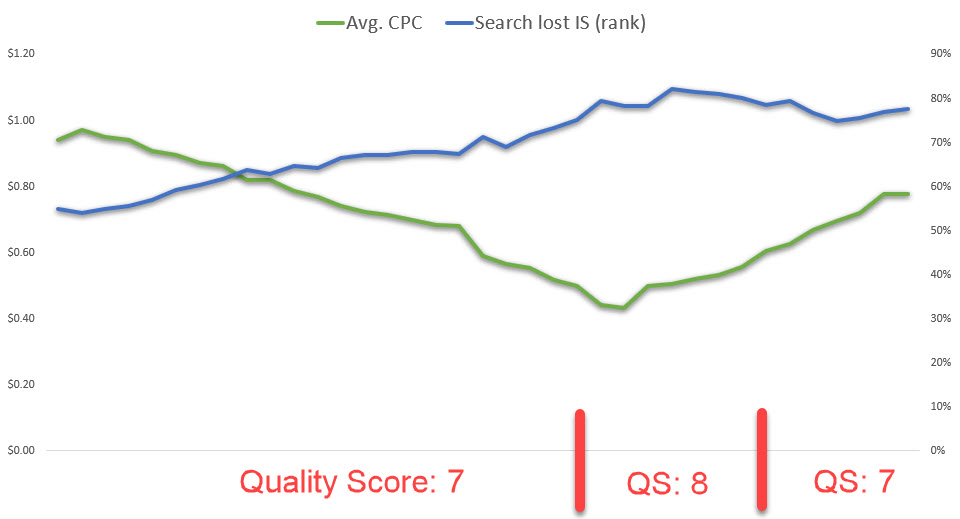
Here’s an example from an account we manage at Portent. In this instance, a keyword saw its Quality Score increase from 7 to 8 and then back down to 7 again after a few days. To see the impact of this change, we measured against the keyword’s Avg. CPC and Lost Impression Share due to Ad Rank over the same time period of time:

Quality Score Improvement Example

*Note: we used a 7-day rolling average of both of these metrics to make the data easily digestible.

This graph shows that during a time period when we decreased bids to compensate for a lower budget, our Lost Impression Share due to Ad Rank— what Quality Score directly impacts— increases at the same steady rate as the Quality Score stays static at 7.

When the Quality Score of the keyword increases to 8, our Lost Impression Share due to Ad Rank stabilizes as bids continue to decrease a bit and stay relatively low. Once bids begin to increase again, our Lost Impression Share due to Ad Rank decreases every so slightly.

After Quality Score changes back to 7, the Lost Impression Share due to Ad Rank stabilizes again and begins to increase even as bids continue to rise.

Other Factors Out of Your Control

There are other factors Google takes into account when assigning Quality Score which you have no control over as an advertiser. Competition for specific keywords in a given industry is the most prominent example. If you’re in an over-saturated search space with tons of competitors, you might never see a quality score over 5 for certain keywords even after extensive optimization.

How do you know if you’re in an over-saturated vertical? Try searching from one of your high-volume keywords and see what type of ad results show up. If you notice there are consistently 4+ ads on the SERP each time you search, you can bet competition is high.

You can also take a look at the auction insights report in Google Ads for any given keyword(s). If you see a list of 8, 10, or more competitors, that too is a sign you’re in a highly competitive market.

Don’t stress about what you can’t control. Focus on the three critical factors you can influence:

  • Expected CTR
  • Ad Relevance
  • Landing Page Experience

Quality Score has a real impact on our paid search performance and how much we pay as advertisers for a given Ad Rank in an auction. While Quality Score should never be a key performance indicator that determines the overall success of your PPC strategy, you should pay attention to how these scores change over time and what impact that has on your performance.

The post Improve Your Quality Scores With These Simple Tips appeared first on Portent.

Thursday, April 4, 2019

Not Using Facebook Offline Events? You’re Missing Out

Facebook Offline Events does something few platforms can: tie online advertising to offline conversions. It is not a new feature in Facebook Ads manager, but few marketers make it a priority in their social media strategy.

Offline event tracking demands significant time and effort to gather customer data, import it into Facebook, and make sure it is consistent. In addition, API integration may demand scarce development resources.

However, businesses with brick-and-mortar presence can reap major benefits. Advertisers can unearth an added layer of conversion metrics driven by their campaign efforts.

If you’re not familiar with Facebook Offline Events, keep reading. If you’re already convinced and want to learn more, read our real-world example, below.

What are Facebook Offline Events?

Facebook Offline Events give advertisers the ability to upload customer data and track which offline events in the customer journey were influenced by their ad campaigns. A custom value can be assigned to each designated event, allowing advertisers to measure their Return on Ad Spend (ROAS) directly within the platform.

Tying your offline conversion events (and conversion values) back into the Facebook ad platform provides advertisers with a level of tracking not otherwise available through the platform. This tracking is the best way for advertisers to track online-to-offline performance for their ad campaigns.

While you may immediately think these offline events only apply to in-store purchases, it also allows advertisers to track phone calls, coupon redemptions, and appointments booked among other offline conversion points. Any action that is not recorded online and may contribute to an eventual conversion is trackable.

Below are a handful of examples where offline event tracking is useful:

  • A customer redeems a coupon for a free service
  • A customer places an order over the phone
  • A customer books an appointment in-person

How Do I Upload a Data Set For Facebook Offline Events?

Getting started with Offline Events on the platform is all about the data set you upload.

When putting together your data set, advertisers must upload the following:

  • Customer details (name, email, and/or phone number)
  • Event details (if it was a lead, registration, purchase, etc.)
  • Event value (the dollar value of the event detail that occurred)
  • An accurate timestamp of the conversion event

Ideally, upload your data to the platform daily. The more often your data set is uploaded, the more reliable your data insights will be. Find full details on how to upload a data set to the platform here.

Facebook uses the customer data included in the data set to determine which users converted offline after engaging with your Facebook campaign. The proper attribution model makes tracking more accurate.

What are the Benefits of Using Facebook Offline Events?

Properly using Facebook Offline Events adds a much-needed data layer to any advertiser optimizing their ad campaigns around conversion points that happen offline. We’ve seen advertisers in a wide variety of verticals benefit. Some fit the typical offline conversion model. Others do not.

Harvard Business Review analyzed the value of a like and determined that although engagement on social media does not translate directly to sales, advertising does.

Upwards of 80% of the marketers surveyed couldn’t quantify their social media efforts at that time. Two years later, the issue still exists.

Combine that with the fact that 90% of retail sales still occur offline, and it is likely that your Facebook campaigns are contributing significantly more to the customer journey than you know.

To ensure that your Facebook advertising strategy is getting the proper credit it deserves, companies who operate offline in even the smallest capacity should take advantage of the ability to match offline conversions to their Facebook campaigns.

If your business or customers interact with your brand offline in any way and you’re not tracking offline events, you’re missing value in the tracking of your marketing efforts.

For businesses where conversion points only occur in a physical store, it’s nearly impossible to determine the impact of your digital marketing efforts without some kind of offline conversion tracking. Businesses built purely with physical locations typically have minimal conversion events on their site, making it even harder to determine campaign effectiveness.

For many of these advertisers, the majority of their Facebook campaigns are optimized to build Reach or Brand Awareness. As an advertiser, it can be difficult to wade through the vagueness of the Brand awareness algorithm, especially since the main KPI attached to the objective is estimated and in development.

With offline event data, advertisers can finally put together a closer-to-complete picture showing the direct conversion impact of a social media campaign.

A Real-World Example

We have a client whose only financially-tied conversion points come offline. They have top-of-the-funnel conversions on their site, but those pale in comparison to the importance of their offline conversion points.

Historically, they have used Reach and Brand Awareness metrics as key performance indicators of their Facebook ad efforts.

After putting together a detailed data set, our client uploaded roughly 400,000 purchase events from the last three months to the Facebook platform.

Using their selected attribution window of 7-day click (users who purchased in 7 days after clicking an ad), we were able to directly attribute over 1,000 of those purchases during February.

The ability to upload and track the offline data allowed us to show a ROAS just a touch over 400%.

Without the ability to upload this information and track it using Facebook’s Offline Events, we wouldn’t be able to track the effectiveness of the campaign to the level of granularity we did – taking significant measurement and credit away from the effectiveness of the campaign.

Regardless of the amount of revenue generated offline, any advertiser with an offline touch point can benefit from understanding exactly what events are driven by their Facebook campaigns.

If you are not utilizing offline events through Facebook’s ad platform, you are missing out on a piece of your paid social ROAS.

And for some advertisers, that may be a large piece. For others, it may be just a small sliver, but why leave a stone unturned when tracking the effectiveness of your paid social efforts on Facebook?

The post Not Using Facebook Offline Events? You’re Missing Out appeared first on Portent.